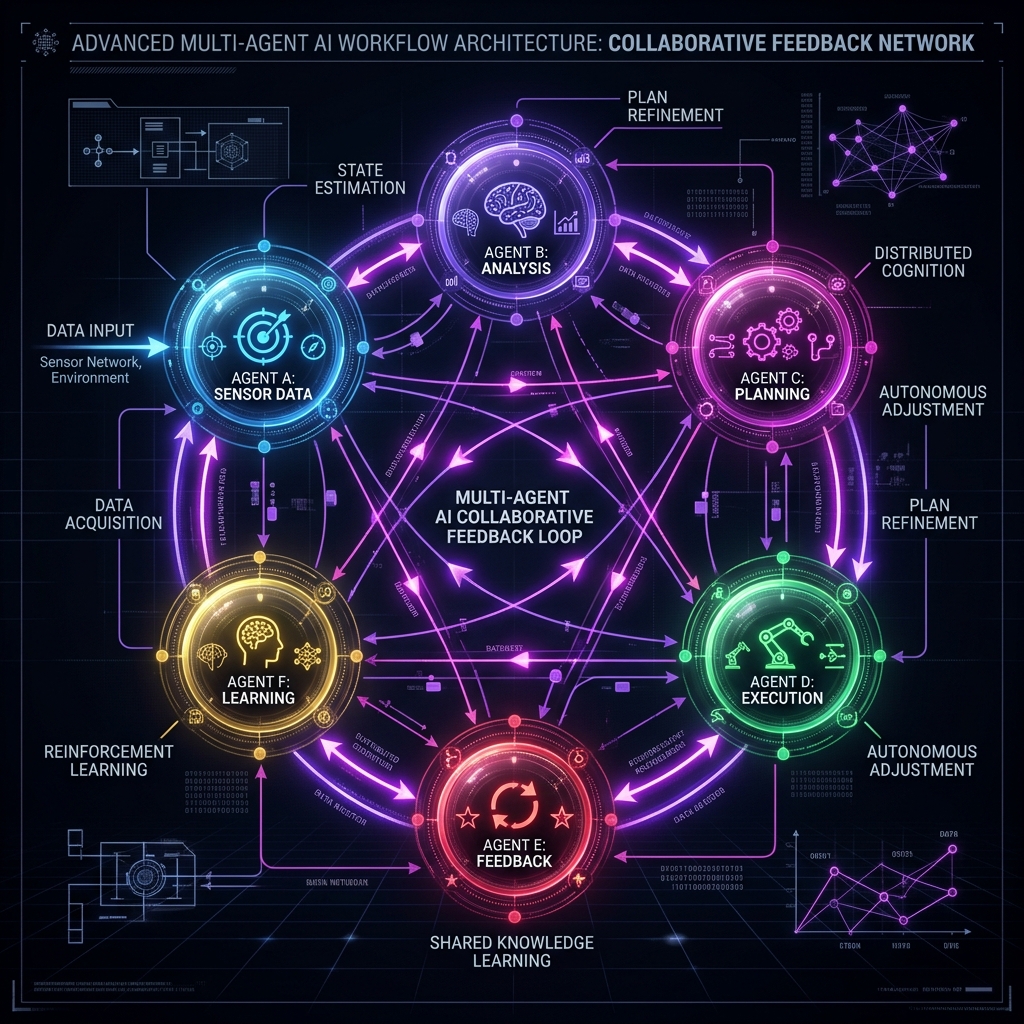
While first-generation generative AI focused on conversational chat inputs, the future of enterprise software is agentic. Multi-agent networks represent a shift from passive query-response interfaces to autonomous execution loops capable of planning, collaborating, and executing complex workflows.
1. The Limit of Single-Prompt AI
Standard LLM applications rely on a single prompt-response structure. If a task requires research, code generation, testing, and deployment, a single prompt inevitably fails due to complexity. Multi-agent systems resolve this by dividing the workflow into discrete roles, allowing specialized agents to cooperate, critique, and correct one another.
2. Defining Stateful Agents with LangGraph
First-generation agent frameworks (like LangChain AgentExecutors) relied on simple linear execution. This meant agents easily got stuck in infinite loops. LangGraph solves this by modeling multi-agent workflows as stateful graphs:
- Nodes: Represent active agents or function executions (e.g., a "Research Agent" node or a "Code Compiler" node).
- Edges: Control the flow between nodes. Conditional edges allow the graph to route execution dynamically based on an agent's output.
- State: A shared, immutable memory object passed along the graph, storing conversation history, database records, and active task progress.
3. A Sample Multi-Agent Pipeline
Consider an automated customer support triage loop:
- Triage Agent: Ingests the ticket and classifies it (e.g., billing vs. technical bug).
- Database Agent: Pulls matching transaction records or log histories.
- Drafting Agent: Formulates a personalized, context-aware resolution email.
- Supervisor Checkpoint (Human-in-the-Loop): Pauses execution, requiring a support manager to approve the response before it is sent.
4. Enterprise Business Value
Multi-agent architectures enable high-autonomy operations:
- 90% Workflow Speedups: Execute multi-step tasks like software logging audits, automated market analysis, or billing reconciliations in seconds.
- Consistent Quality Guards: Built-in critic agents audit the outputs of worker agents, automatically rejecting substandard work.
- Human-in-the-Loop Safety: Keep operations fully controlled by forcing graphs to request approval before writing to databases or executing payments.
The Path Forward
As companies move past basic chatbots, multi-agent frameworks will become the core operating system of enterprise backend automation, enabling businesses to deploy self-correcting software agents that operate 24/7.